
Energy Management and Environmental Investments
Energy management is critical to building a sustainable future. By taking pioneering steps in combating climate change, we aim to minimise environmental impacts and systematically reduce our carbon footprint through energy efficiency solutions. Risks highlighted in the World Economic Forum’s Global Risk Report, such as climate change, natural disasters and resource management, are at the heart of our sustainability strategies. With this awareness, we prioritise both renewable energy investments and projects that will make our existing infrastructure more efficient.
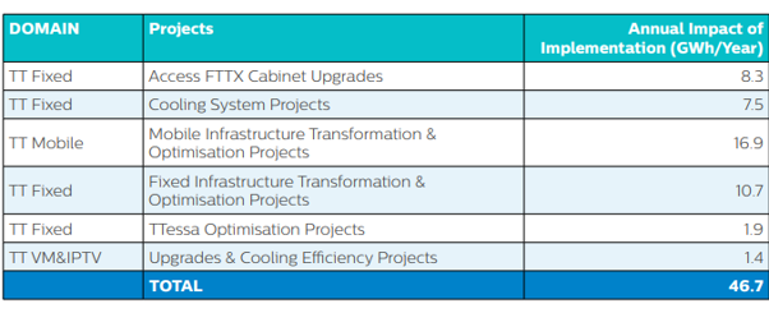
We are resolutely continuing our work on energy efficiency and management at all locations where we operate across Türkiye. In 2025, we achieved energy savings of 29.8 GWh through fixed infrastructure transformation and optimisation projects, and 16.9 GWh through mobile infrastructure investment, transformation and optimisation projects.
With the projects we have implemented, we achieved a total energy saving of 46.7 GWh in 2025. While promoting alternative solutions such as solar energy, we are minimising our environmental impact by integrating digital and smart systems that optimise resource consumption.
Our target for reducing energy consumption in these areas was 4% for 2026.
Energy Intensity
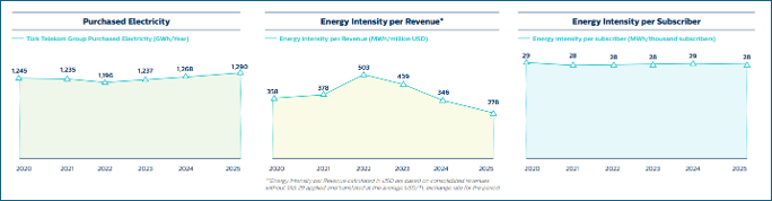
In 2025, consolidated energy intensity per net revenue in USD decreased by 20% compared to the previous year, reaching 278 MWh/ million USD, due to the impact of our energy efficiency projects and renewable energy investments. In contrast, energy intensity per subscriber has fallen by 3% year-on-year. This decline demonstrates the effectiveness of the efficiency projects implemented and the energy management measures put in place, despite the expansion of the operational scale.
While a decrease in the number of fixed voice subscribers was observed due to technological transformation, there was a significant increase in the total number of mobile, fixed broadband and TV subscribers. Since 2020, despite a 25% increase in the number of subscribers excluding fixed voice, the amount of purchased electricity has remained nearly constant.
With the efficiency projects we implemented in 2025:
Energy Efficiency and Sustainable Network Solutions
✓ We implemented sustainabilityfocused solutions by selecting antenna models that reduce our energy consumption by up to 15%.
✓ We optimised the addition of capacitive equipment in a way that does not negatively impact customer experience, reducing energy consumption in the field.
✓ With 3G to 4.5G transition investments in all cities, we reduced the energy spent to carry the same amount of data by 50%.
✓ Our “Power Saving & Fibre Optimisation” initiatives implemented on 3G and 4.5G networks resulted in energy savings of 7.3 GWh.
Networks Powered by Renewable Energy
As part of the projects, we implemented in 2025, we integrated solar energy systems with a total capacity of 1.4 MW into 436 base stations. With this investment, we increased the total installed capacity of our rooftop renewable energy systems at our base stations and fixed buildings to 6.9 MW. Thanks to the more effective use of solar energy in our telecommunications infrastructure, we achieved an additional saving of 2.2 GWh in our energy consumption in 2025. Our renewable energy investments contribute to our sustainable growth by reducing our carbon footprint and decreasing our dependence on external energy sources. With this approach, we will continue our investments in rooftop renewable energy systems at our base stations and fixed buildings in the coming years.
Renewable Energy Investments
We completed preparatory work for the first phase of the 405.8 MWe solar power plant capacity, which accounts for approximately 65% of our total energy consumption, by the end of 2024. Within this scope, we commissioned the Sivas Solar Power Plant investment, which we started installing at the beginning of 2025 by the end of the year. The Sivas SPP, which constitutes the first stage of our three-stage investment plan, ranks among Türkiye’s highest-capacity unlicensed solar energy plants with an energy production capacity of 96 MWe / 128 MWp. Our SPP field has the capacity to meet approximately 15% of our total annual energy needs. In addition, we have completed the legal permit processes for our Malatya and Ağrı SPP projects. Following the completion of the tender processes in 2026, we plan to move on to the installation phase and aim to complete our investments in both provinces within the next two years. In addition to these projects, our group company AssisTT has completed the installation of a 240 kWe rooftop solar power plant at its facility in Adıyaman as part of its solar power plant project. This investment aims to meet approximately 13% of AssisTT’s total annual electricity consumption from renewable energy sources.
Digital Transformation in Energy Efficiency: TTessa
Alongside our renewable energy investments, we utilise digitalisation and advanced analytics solutions to manage our existing energy consumption more efficiently. In line with this, we monitor and manage the energy equipment in our fixed and mobile networks through a centralised structure using our TTessa – Smart Energy Management System Platform (Türk Telekom Energy Smart System Application). The platform securely collects data from numerous energy components, including generators, direct current (DC) energy systems, uninterruptible power supplies (UPS devices), air conditioners, natural ventilation units (FCB), digital thermostats, and meters. This data is processed using artificial intelligence-supported analyses, enabling us to improve operational quality while managing energy consumption more effectively.
As a result of new developments made on the TTessa platform throughout 2025, we achieved an additional 1.9 GWh of energy savings on top of previous years’ savings. This result stands out as a tangible outcome of our data-driven management approach, while the system’s userfriendly interface has significantly increased efficiency and control capabilities in our field operations.
Our TTessa project, which is the world’s most comprehensive AI-supported project in its field, was awarded first place in the ‘Digital Transformation’ category among 613 projects evaluated in 11 categories at the 10th Efficiency Project Awards organised by the Republic of Türkiye Ministry of Industry and Technology.
Productivity and optimisation projects carried out in 2025:
Energy Efficiency and Network Optimisation We plan to develop artificial intelligence solutions in our energy and cooling infrastructure. This system enables us to optimise our energy consumption and make our operational processes more efficient. We are making our energy consumption more efficient by continuing our work on the “Fibre Optics and Power Saving” feature and parameter optimisation in our mobile base stations.
More Efficient Use with Advanced Cooling Technologies
The improvements we have made to our cooling systems, which account for a large portion of our energy consumption, play a significant role in increasing our energy efficiency. By 2025, we will have replaced the old generation air conditioning systems used in fixed and mobile networks with new generation efficient devices, thereby reducing energy consumption. In addition, we have promoted the use of free cooling box systems to enable base stations and telecommunications system rooms to be cooled at low cost using outside air. As a result of these transformations, we have achieved an annual energy saving of 8.9 GWh in our fixed and mobile networks.
Energy Efficiency in Data Centres
Data centres are, by their very nature, critical infrastructure facilities that consume high levels of energy. As Türk Telekom, we are undertaking a comprehensive transformation process to make these energy-intensive structures more efficient and sustainable. We operate three commercial data centres in Ümitköy, Esenyurt and Gayrettepe, as well as Türk Telekom’s own data centres in Ümraniye and Ahlatlıbel.
As part of the new customer lounge construction project, we carried out at our Esenyurt Data Centre, we successfully commissioned two new commercial areas with a total of 2 MW IT power, 1,000 m2 of white space and 288 cabinet capacity. Within the scope of this project, we set a target of 1.35 PUE in line with our new generation and sustainable data centre vision. To achieve this target, we completed the project by implementing a cooling infrastructure featuring an air-cooled Chiller + Computer Room Air Handler (CRAH) architecture. Furthermore, in line with our work on next-generation cooling technologies at our Esenyurt Data Centre, we have also successfully completed the first phase of the Immersion Cooling Project. In this phase, we commissioned two Immersion Cooling tanks with a 50 kW IT power capacity, targeting an average PUE of 1.08.
At the Ümitköy Data Centre, we implemented the Artificial Intelligence-based Cooling Optimisation Project in 2025. With this project, we reduced energy consumption from cooling and the associated emissions by 28.4%. Thanks to the effects of the Climate Change and Artificial Intelligence-Supported Cooling Optimisation Project, we reduced our average PUE at the Ümitköy Data Centre from 1.64 to 1.56. At the same time, we saved approximately 1,750 tonnes of water with the Misting System integrated into the outdoor units of the cooling equipment.
In line with our energy efficiency targets, we aim to reduce the PUE value of our existing data centres to 1.4 and target a value of 1.2 for newly constructed data centres. Thanks to the energy efficiency projects implemented, the average PUE value of our data centres, which was 1.8 in 2020, has fallen to 1.54 as of 2025. With the efficient halls we have recently commissioned, we anticipate that this value will approach 1.5 within 2026.
Strategic Steps Towards Energy Savings Our work on energy efficiency not only contributes to environmental sustainability, but also enables us to optimise our energy costs by increasing our operational efficiency. With our sustainability-focused approach to energy management, we continue to invest in the future and develop innovative solutions to build a lowcarbon and more efficient telecommunications infrastructure.
We are continuing our GPON investments
Gigabit Passive Optical Network (GPON) is a high-speed network standard used for internet access, primarily implemented in fibre optic broadband infrastructures. Compared to traditional copper-based networks, references in international studies indicate that GPON infrastructure provides approximately 95% higher energy efficiency. Furthermore, it contributes to reducing greenhouse gas emissions due to its lower maintenance requirements. In this context, the gradual decommissioning of copper-based networks also creates indirect environmental benefits. Over the last six years, we have achieved a total energy saving of 118 GWh* by migrating approximately 5 million subscribers to GPON infrastructure. We plan to continue our GPON infrastructure investments beyond 2025.
*This refers to the annual energy savings achieved by converted subscribers.
Technological Infrastructure and Efficiency Projects
In 2025, while focusing on ensuring the continuity of our energy and cooling infrastructure, we continued to optimise all our operational processes with high performance and digital control principles. By making the most of the technological capabilities provided by our local and national energy management platform TTessa across the network, we monitored all our infrastructure devices, including air conditioning, generators, uninterruptible power supplies, and DC energy systems, in real time. We have made our energy management operations autonomous with six AI-supported usage scenarios developed within the TTessa Platform. In this context, we have implemented advanced technology solutions such as autonomous efficient air conditioning and generator operation, autonomous air conditioning troubleshooting, and free-cooling optimisation integrated with meteorological temperature data. Through real-time electricity consumption analyses and performance monitoring studies we carry out via TTessa, we have further strengthened our strategic actions towards reducing our environmental impact by managing our energy resources in the most efficient way.
With the technological modernisation initiatives, we have undertaken in our cooling infrastructure, we have prioritised next-generation solutions that maximise energy savings in our system rooms and data centres. By increasing the utilisation capacity of our free cooling devices, we have maximised the benefits of the free cooling method under suitable climatic conditions. Through hall optimisation efforts, we have achieved significant space savings while also implementing precision cooling throughout the system hall. Furthermore, through network card and system optimisation efforts in our system halls, we have identified idle equipment and either deployed these devices at different points where needed or added them to our spare inventory.
In line with our corporate sustainability vision, we continued our central modernisation and AC-DC (alternating current to direct current) transition projects in our intranet infrastructure in accordance with our low-carbon economy goals. We strengthened our data transmission capacity with new-generation hierarchies such as MPLS (Multi-Protocol Label Switching) and DWDM (Dense Wavelength Division Multiplexing), while optimising the energy intensity per device by simplifying our hardware. We have reinforced our energy supply security with new generation lithium battery groups and generator systems, while continuing to maintain our pioneering role in Türk Telekom’s journey towards its 2050 “Net Zero” emissions target with the data-driven insights provided by our digital monitoring systems.
Strategic partnerships with our suppliers have also been crucial in our technological transformation process. Under a buyback agreement with one of our key international suppliers, we have contributed to our environmental sustainability goals by recycling end-of-life radio equipment. In our antenna purchases, we have increased efficiency in our networks by choosing models that consume less energy and provide up to 15% energy savings. At the same time, we have optimised the process of adding capacity equipment in a way that does not disrupt the customer experience, aiming to reduce energy consumption in the field.
We accelerated our efforts to convert 3G bands to 4.5G technology across all cities. With this conversion, we have managed to reduce the energy consumed to carry the same data volume by 50%. Furthermore, thanks to the “Power Saving & Fibre optimisation” optimisations we have carried out on 3G and 4.5G networks, we have achieved a total energy saving of 7.3 GWh. We focused on the infrastructure preparations required for the use of 5G technology in 2025, which is expected to improve energy efficiency by up to tenfold and reduce energy consumption per unit of data to nearly 10% of current levels with the launch of 5G usage across the country.
As part of our efforts to save network energy and increase operational efficiency, we completed the installation of SPP + Network electrical systems with a capacity of 3 KW per site in a total of 907 sites by the end of 2025.
Within the scope of our signal improvement efforts in locations where energy infrastructure is lacking or limited, we have implemented SPP Caravan (solar energy + generator hybrid system) applications with a capacity of 8 kW per site in a total of 21 sites by the end of 2025, thereby avoiding high energy infrastructure costs. As part of the rollout of these applications, we plan to increase the number of sites where the SPP + Grid Electricity solution is implemented to over 400 in 2026, and to add 20 new sites to the number of sites where the SPP Caravan solution is implemented.
Energy Management and Certification
We conduct our energy management practices in line with national and international standards, adopting a holistic approach to reducing the environmental impact of our operations. In this context, we manage our energy consumption, environmental and sustainability practices in accordance with internationally recognised certifications such as the ISO 50001 Energy Management System, ISO 14001 Environmental Management System and I-REC. We regularly verify the accuracy and traceability of our data through independent third-party audits. All our service areas across Türkiye are ISO 14001 certified, ensuring that environmental impacts are systematically monitored and managed. To reinforce our commitment to energy efficiency, we have elevated the ISO 50001 Energy Management System certification process, which we initiated for our data centres in previous years, to a strategic level as of 2025. In this context, in addition to our data centres, we have successfully completed the ISO 50001 certification process for all our locations that meet TEP (Tonnes of Oil Equivalent) values and fall within the legal scope in all our power plant buildings across Türkiye. As a result, we have expanded our international energy management standards to cover all our critical infrastructure facilities, marking an important milestone towards our sustainability goals.
We calculate our energy consumption data based on relevant national and international standards, primarily TSE and ISO 50001. Data for different energy sources, such as electricity, gas and heat, is collected and analysed in accordance with standardised calculation methods and procedures. In our calculations, we use official conversion factors determined by the competent authorities in the energy sector and verified data obtained from reliable sources, thereby creating a consistent and comparable data infrastructure that supports our sustainability goals.
We conduct efficiency-focused work to improve our performance by regularly monitoring energy intensity and electricity consumption. In this context, we implement practices aimed at achieving a reduction in energy consumption each year compared to the previous year, adopting a low-carbon and sustainable energy management approach. Through projects and measures to optimise energy use, we continue to create a more efficient and resilient business model while reducing our environmental impact.
R&D and Technology Investments for Reducing Environmental Impact
As part of our R&D activities aimed at reducing environmental impacts, increasing operational efficiency and strengthening infrastructure resilience, we continue to invest in environmentally focused technologies. In this context, we aim to reduce our environmental footprint through our R&D efforts. Our environmental R&D initiatives include digital solutions such as the Türk Telekom Smart Manhole Monitoring System, which enables the monitoring of environmental risks in infrastructure operations and the development of preventive maintenance processes, as well as solutions for remote monitoring of field equipment, improving energy efficiency and reducing potential environmental impacts. In 2025, our total investment in R&D projects focused on environmental impact reduction and sustainable technology development amounted to 179 million TL.